
High Altitude Heat Pump Repair in Summit County, CO
Operating a heat pump at elevations above 8,000 feet introduces complex mechanical challenges that standard sea-level HVAC systems never encounter. In mountain communities like Breckenridge, Keystone, Dillon, Silverthorne, and Frisco, thin mountain air and brutal winter cold snaps force heat pump compressors and defrost systems to work significantly harder.
When heating performance drops during peak resort season, fast mechanical intervention protects residential homes and commercial properties from frozen pipes and severe building damage. High Country Fix It delivers specialized heating and mechanical services built specifically for high-altitude environments.
For complete facility reliability and climate control support, scheduling professional commercial refrigeration repair in Summit County, CO ensures all critical mechanical infrastructure runs smoothly when winter weather hits hardest.
How High Altitude and Low Air Density Impact Heat Pumps
As elevation rises, atmospheric pressure drops sharply, producing air that is far less dense than at lower elevations. Because heat pumps depend on moving physical air mass across heat exchanger coils to extract and transfer thermal energy, thinner air inherently cuts total system heating output. Compressors must operate under significantly higher compression ratios to push enough thermal energy into the structure.
Thin mountain air also speeds up frost accumulation on outdoor condenser coils during freezing weather. As moisture freezes across aluminum fins, the heat pump must enter a defrost cycle, temporarily reversing operation to clear ice. When ambient sensors or defrost control boards malfunction in sub-zero weather, the system freezes over entirely, forcing the property to rely on expensive auxiliary electric heat.
Maintaining long-term system reliability demands precise refrigerant charging and custom airflow calibration designed for mountain conditions. Without these technical adjustments, standard heat pumps suffer from severe thermal overload, premature compressor failure, and erratic heating performance when outdoor temperatures plunge.
Common Heat Pump Failures in Mountain Resort Towns
| Failure Mode | Mechanical Cause | Mountain Environmental Driver |
|---|---|---|
| Extended Defrost Cycles | Ice lockout on outdoor coils | Heavy snowpack and extreme sub-zero humidity |
| Thermal Overload | High compressor pressure ratios | Thin air density and elevated lift requirements |
| Refrigerant Leaks | Micro-fissures in copper joints | Rapid freeze-thaw thermal expansion cycles |
| Auxiliary Heat Burnout | Continuous backup element usage | Heat pump capacity loss above 8,000 feet |
For reliable system diagnostics and fast repair response times, scheduling professional heat pump repair prevents unexpected winter heating failures. Routine maintenance and complete HVAC equipment service ensure your system maintains stable heating performance throughout sub-zero mountain weather.
1. Defrost Controller and Sensor Malfunctions
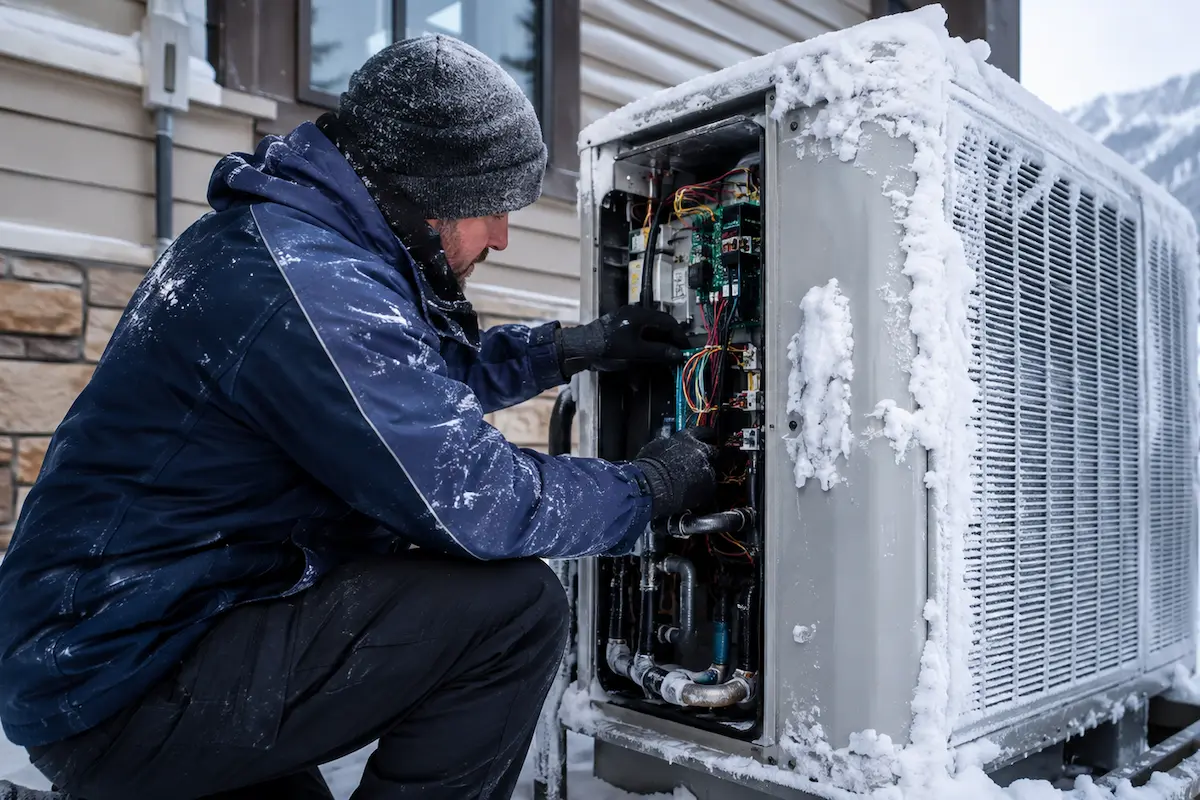
Blowing snow and severe ice storms in Summit County cause rapid frost buildup across outdoor coils. Heat pumps rely on precision thermistors and defrost control logic boards to initiate timely heating cycles that clear external ice. If sensors misread coil conditions due to snow drift accumulation or component failure, the defrost cycle fails to engage.
Ice completely encases the outdoor cabinet, bending fan blades, crushing sensitive coil fins, and blocking all thermal absorption. Technicians must manually de-ice the cabinet, test sensor resistance, and reconfigure defrost control logic to prevent repeat freeze lockouts.
2. Low Refrigerant Charge and Micro-Leaks
Refrigerant serves as the core medium for absorbing ambient outdoor heat and transporting it inside. Extreme temperature swings across Colorado mountain towns put constant stress on copper line sets, flare fittings, and service valves, creating microscopic leaks over time. A minor loss in refrigerant pressure drastically undermines heating performance at high altitude.
Because ambient mountain air already carries less dense heat energy, an undercharged heat pump cannot elevate supply air temperatures, leaving the system running constantly while indoor temperatures continue to drop. Refrigerant serves as the core medium for transferring ambient heat indoors, where even tiny leaks lead to severe system failure under high-altitude conditions.
Technicians must address these leaks following official EPA refrigerant standards to maintain safe system pressures and prevent compressor burnout.
3. Auxiliary Resistance Heat Lockout
When primary heat pump capacity drops during intense freeze events, systems engage auxiliary electric heat strips to maintain thermostat settings. While effective for brief backup support, relying continuously on electric resistance heat creates skyrocketing energy bills and strains electrical panels.
Routine servicing checks reversing valve operation, staging controls, and outdoor ambient cut-off switches. Properly setting these mechanical controls ensures the primary heat pump carries the main heating load efficiently, engaging backup heat strips only when ambient temperatures cross true design thresholds.
High-Altitude Heat Pump Diagnostic Protocols
Airflow Measurement: Gauge static pressure Measurement: Gaugeand CFMEnsures proper air mass passes over indoor coil
| Inspection Step | Technical Action | Operational Benefit |
|---|---|---|
| Refrigerant Calibration | Adjust subcooling for elevation | Prevents compressor overheating and lift failure |
| Defrost Verification | Test sensors and reversing valve | Eliminates outdoor coil ice buildup and freeze-ups |
| Auxiliary Heating Test | Inspect staging and amp draw | Cuts unnecessary electric strip usage and utility costs |
Diagnosing mountain heating equipment requires specialized tools designed to measure low atmospheric pressure and accurately calculate superheat and subcooling levels. Using standard sea-level pressure charts causes incorrect refrigerant charging, leading directly to premature equipment failure.
Technicians carefully check static pressure across air handlers, inspect blower wheel pitch, and clean indoor and outdoor coils to restore optimal thermal exchange. Ensuring unrestricted airflow lets the system push adequate air mass across the heat exchanger, keeping compression ratios within safe operating ranges
Preventative maintenance remains the most effective defense against sudden winter heating failures. Regular coil washing, electrical connection tightening, fan motor lubrication, and high-altitude refrigerant checks keep heat pumps operating dependably through the toughest winter conditions.
Frequently Asked Questions About High-Altitude Heat Pump Repair
How does high altitude affect heat pump heating efficiency in Summit County?
At higher elevations, lower air density reduces the amount of oxygen and mass moving across outdoor coils. This lowers overall thermal transfer capacity, forcing the compressor to work harder and making precise system calibration critical for maintaining steady heat.
Why does my outdoor heat pump coil keep freezing into a solid block of ice?
Outdoor coils freeze over when defrost sensors fail, refrigerant levels drop, or snow blocks natural airflow around the cabinet. In mountain environments, failing to clear this ice quickly can damage fan blades, crush aluminum coil fins, and lock out the system entirely.
Are heat pumps effective as primary heat sources in sub-zero mountain winters?
Modern cold-climate mini-splits and inverter-driven heat pumps perform exceptionally well at low temperatures. However, at high altitudes, they require properly calibrated auxiliary heat backup and correct outdoor temperature cut-off settings to maintain comfort during extreme freeze events.
What causes heat pump compressors to fail prematurely in mountain towns?
Compressors fail prematurely when forced to run under high compression ratios caused by thin air, restricted coil airflow, or improper refrigerant charges. Annual preventative maintenance helps balance internal system pressures and prevents thermal breakdown.