Commercial Ice Machine Making Cloudy Ice? Mountain Fixes
In the high-altitude environments of Breckenridge and Vail, restaurant owners often find their commercial ice machine making cloudy ice unexpectedly. This frustrating issue can negatively impact the presentation of premium cocktails and the perceived quality of your establishment. At High Country Fix It, we specialize in solving these specific mountain refrigeration challenges for local businesses throughout Summit County.
When a commercial ice machine produces white or opaque cubes, it is usually a sign that air or minerals are trapped within the ice. While many assume this is a cosmetic flaw, it often points to underlying mechanical or water quality issues that require expert care. Understanding why is my restaurant ice machine making cloudy ice requires a deep dive into the unique physics of the Colorado Rockies, where timely ice machine repair ensures your system runs smoothly.
How High Altitude Affects Commercial Ice Clarity
Operating commercial ice machines at elevations above 9,000 feet presents unique challenges that lowland technicians rarely encounter. The atmospheric pressure in places like Keystone and Silverthorne affects how water boils and freezes, often requiring specific adjustments to the machine’s cycle. If your equipment isn’t calibrated for these heights, you may experience frequent cloudiness due to rapid or uneven freezing.
High altitude ice machine troubleshooting often reveals that the water fill cycle and the harvest cycle are out of sync with the local air pressure. This imbalance can cause the machine to trap excess air bubbles during the initial freeze, leading to that dreaded milky appearance. Our team ensures your mountain refrigeration system is tuned perfectly to the local environmental conditions for optimal clarity.
Beyond air pressure, the physical components of your machine work harder in mountain locations where seasonal water temperatures fluctuate wildly. Cold mountain water is excellent for ice production, but if the machine’s internal settings aren’t adjusted, the rapid transition from liquid to solid can trap gases. This phenomenon is a primary reason why high altitude ice machine troubleshooting is a specialized field.
The Role of Total Dissolved Solids (TDS) and Scale
One of the most common culprits for opaque ice in Dillon and Frisco is a high concentration of total dissolved solids (TDS). These are inorganic salts and organic matter that remain in the water as it freezes, pushed toward the center of the cube. As the ice forms from the outside in, these impurities concentrate, creating a white, cloudy core.
If you are wondering how to clean commercial ice maker evaporator scale, you are likely already seeing the effects of mineral buildup. Calcium and magnesium, common in our local water sources, eventually coat the evaporator plates, making it difficult for the ice to release properly. This scale not only ruins ice clarity but also forces the machine to consume significantly more energy.
When the evaporator is covered in mineral deposits, the water flow becomes turbulent rather than a smooth, laminar sheet. This turbulence introduces even more air into the freeze cycle, compounding the cloudiness caused by the minerals themselves. Regular ice machine repair and professional descaling for commercial ice machines are essential to prevent this buildup from permanently damaging your expensive kitchen equipment.
Critical Solutions for Summit County Businesses
To maintain clear ice in any resort town, a robust commercial ice maker water filtration Summit County strategy is absolutely mandatory. Standard off-the-shelf filters often fail to address the specific sediment and mineral profiles found in the Snake River or Blue River watersheds. A high-quality water filter cartridge replacement should be performed at least every six months.
The freeze cycle purge valve is another critical component that frequently fails or becomes clogged in high-mineral environments. This valve is responsible for flushing out the concentrated mineral water at the end of every cycle to ensure the next batch starts fresh. If the valve sticks, those concentrated minerals remain in the reservoir and end up in your customers’ drinks.
Our technicians focus on mountain commercial ice maker repair that addresses both the mechanical and chemical aspects of ice production. By combining proper filtration with precise mechanical calibration, we can transform cloudy, soft ice into hard, crystal-clear cubes. We service all major brands, ensuring your system operates at peak efficiency regardless of the demanding mountain climate.
Troubleshooting Guide for Ice Clarity
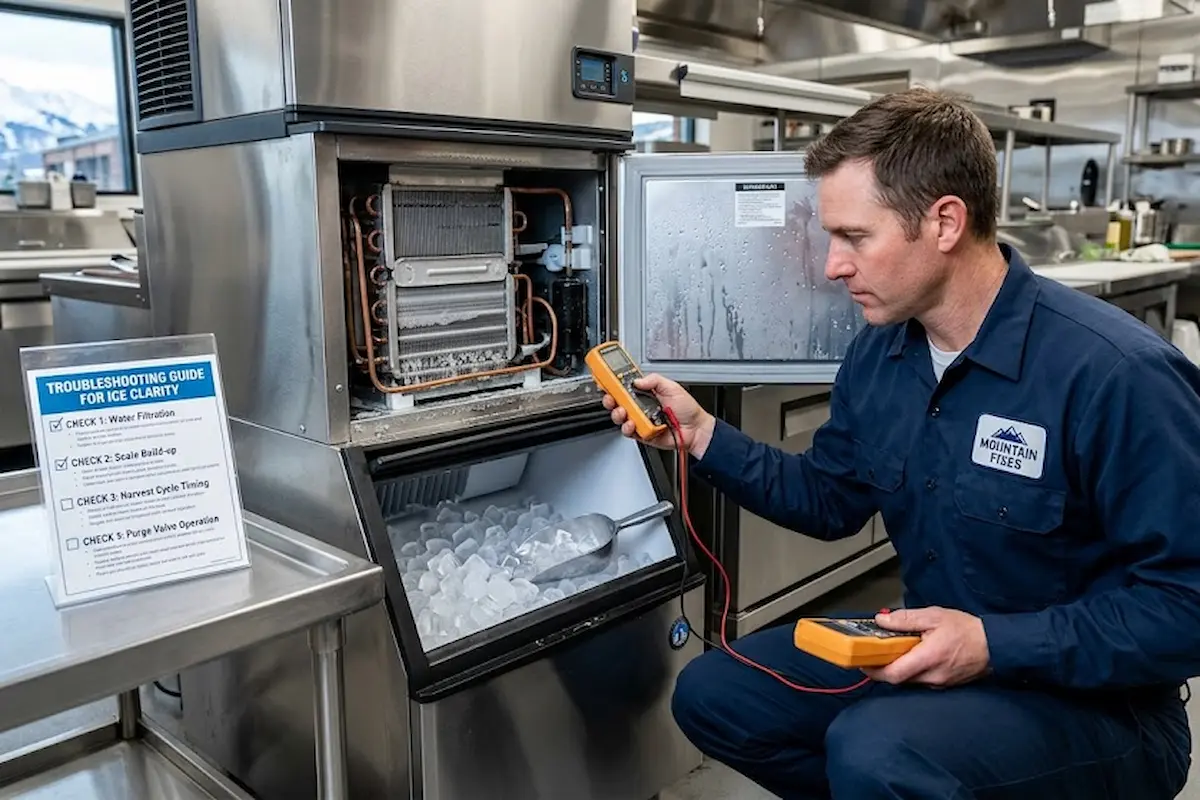
| Symptom | Primary Cause | Recommended Mountain Fix |
|---|---|---|
| White core in cubes | High Total Dissolved Solids (TDS) | Install high-capacity filtration |
| Small, cloudy cubes | Clogged water distribution tube | Deep clean and descale machine |
| Opaque, soft ice | Defective freeze cycle purge valve | Replace valve and check drainage |
| Scale on evaporator | Mineral buildup from hard water | Professional acid wash and descaling |
| Irregular cube shape | High altitude pressure imbalance | Adjust harvest timing and water level |
Maintaining Your System for Long-Term Clarity
Preventative maintenance is the only way to avoid the sudden onset of cloudy ice during the busy ski season. Scheduling a comprehensive ice machine repair session before the winter rush ensures that your evaporator plates are clean and your sensors are calibrated. Our local experts provide specialized service that accounts for the heavy usage and environmental stresses of Summit County.
A technician-led deep clean involves more than just running a cleaning solution through the machine’s internal cycle. We manually scrub the sensors, inspect the water pump, and ensure the water filter cartridge replacement is suited for the local water hardness. This level of detail is what separates a standard repair from a professional mountain refrigeration service plan.
Remember that a commercial ice machine making cloudy ice is often a warning sign of an impending total system failure. Scale buildup can lead to a cracked evaporator, which is one of the most expensive repairs a restaurant owner can face. Investing in regular maintenance now saves thousands of dollars in emergency repairs and lost revenue during the peak season.
Technician Insights: Why Mountain Water is Different
Local technicians often notice that water in Breckenridge and Keystone has a unique mineral profile that changes with the snowmelt. During the spring runoff, sediment levels can spike, quickly clogging standard filters and causing immediate issues with ice clarity. This seasonal shift requires a proactive approach to commercial ice maker water filtration Summit County businesses can rely on.
We often find that the freeze cycle purge valve is the most neglected part of a mountain ice machine. Many “flatland” technicians overlook this part, but in high-altitude areas, its role in mineral management is absolutely vital. A clean and functioning purge valve is the secret weapon for any bar manager who wants to serve the clearest ice.
Finally, the temperature of the water entering your machine in January can be near freezing, which affects the timing of the cycles. If your machine is not adjusted for these extreme seasonal changes, the mechanical components can undergo significant thermal stress. High Country Fix It provides the local expertise needed to keep your ice crystal clear through every Colorado season.
Frequently Asked Questions
Why is my restaurant ice machine making cloudy ice suddenly?
Sudden cloudiness happens when a clogged water filter or stuck purge valve traps minerals inside the freeze cycle. Inspecting your filter and flushing the valve will quickly restore crystal-clear ice.
How high altitude affects commercial ice clarity exactly?
Lower atmospheric pressure causes dissolved gases to off-gas faster, trapping microscopic air bubbles in freezing water. Recalibrating harvest timers for high elevation keeps the ice forming completely clear.
How to clean commercial ice maker evaporator scale safely?
Circulate a food-grade, nickel-safe descaling cleaner through the machine to dissolve stubborn calcium deposits. A manual scrub by a technician removes any remaining heavy scale without scratching the evaporator plates.
When should I schedule a water filter cartridge replacement?
Replace your water filter cartridge every six months or immediately if water pressure drops below 30 PSI. Routine replacements prevent mineral buildup and keep your ice production running at peak clarity.