Running a kitchen or lodge in Summit County means dealing with extreme elevation and demanding peak resort seasons. Commercial refrigeration equipment operates under constant stress in our high-altitude environment, making proactive maintenance critical for daily service.
When your commercial ice maker begins to fail, it rarely stops working without giving advance warning signs first. Recognizing early indicators of system distress allows you to schedule repairs before experiencing total mechanical failure during your busiest hours.
1. Decreased Ice Production and Slower Freeze Cycles
A sudden drop in daily ice output usually indicates internal component strain or refrigerant system imbalance. High altitude, low atmospheric pressure forces compressors to work significantly harder to maintain the required freezing temperatures.
If your machine takes noticeably longer to complete a single freeze cycle, the evaporator coils may be experiencing thermal transfer issues. Scaled components, restricted thermal expansion valves, or slow refrigerant leaks frequently cause these performance delays.
Addressing production drops early prevents permanent damage to your unit compressor motor assembly. Professional calibration ensures your system maintains proper pressure ratios despite local elevation challenges.
| Warning Sign | Primary High-Altitude Cause | Recommended Action |
| Decreased Ice Production | Low airflow / Compressor strain | Clean condenser coils & check airflow |
| Shallow or Soft Cubes | Scale build-up / Valve leak | Descale unit & calibrate the water valve |
| Loud Chattering Noise | Bearing wear / Water pump failure | Inspect the fan motor & the circulating pump |
| Water Pooling Near Base | Clogged drain line / Tubing leak | Clear drainage lines & fit seals |
If your equipment takes longer to drop a batch, it’s often an early sign that you need commercial ice machine repair in Summit County before production stops completely.
2. Misshapen, Soft, or Cloudier Ice Cubes
High-quality commercial ice should always produce clear, fully formed cubes with consistent density across every single batch. Soft, slushy, or hollow cubes point directly to inconsistent freezing temperatures within the evaporator plate grid.
Water flow restrictions or mineral deposits left behind by local water sources often disrupt uniform distribution across plates. When water cannot flow evenly over freezing surfaces, ice forms unevenly and melts far too rapidly.
Cloudy ice can also signify inadequate water filtration or compromised harvest valve timing within your machine setup. Installing proper filtration systems protects sensitive internal components from premature scale build-up.
3. Strange Noises Coming From the Compressor or Pump
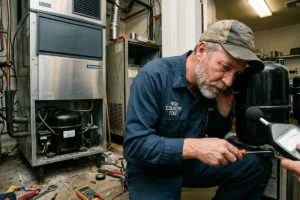
Commercial ice machines operate with standard operational hums, but loud clicking, squealing, or grinding sounds demand immediate attention. Foreign mechanical noises typically indicate failing bearings, water pump strain, or severe compressor friction issues.
At higher elevations, fan motors work harder to draw air through condenser coils to dissipate internal operational heat. Overheating fan motors frequently chatter or screech right before suffering complete electrical coil burnout.
Ignoring unusual mechanical sounds leads to catastrophic mechanical failure that requires expensive full-component replacements. Technicians can replace worn bearings or failing pumps quickly if caught during initial breakdown stages.
Strange noises usually mean the compressor is working under heavy strain, drastically reducing efficiency for commercial ice makers.
4. Water Leaking Around the Base or Storage Bin
Water accumulation beneath your unit or inside the storage bin base signals serious drainage or tubing failures. Leaks often stem from cracked water inlet valves, degraded silicone supply lines, or backed-up condensate drain hoses.
Left unchecked, standing water creates immediate slip hazards for kitchen staff and promotes undesirable bacterial growth in bins. Excess water can also seep into internal electrical compartments, causing short circuits or control board damage.
Regular inspection of water supply lines and drain pathways stops minor drips from turning into major property damage. Prompt repairs keep your kitchen space completely safe, compliant, and fully operational.
Water pooling around your unit is a clear red flag—if you notice leaks, request service immediately to prevent costly water damage.
5. Unexpected Increases in Monthly Utility Bills
A sudden spike in electric or water costs often points straight to an inefficiently running commercial ice machine. When components deteriorate, the unit runs continuously to reach required production temperatures, wasting substantial energy.
Leaking water inlet valves waste hundreds of gallons of clean water by allowing continuous flow down the drain line. Continuously running compressors consume excess electricity while struggling against scaled heat exchangers or dirty coil surfaces.
Monitored utility trends give a clear financial warning that your mechanical systems require professional technical servicing. Timely tune-ups restore factory operational efficiency while lowering overall operational costs for your business.
Expert High-Altitude Maintenance Solutions
Commercial ice machine repair in Summit County CO, relies on deep local expertise regarding high-altitude refrigeration mechanics and pressure adjustments. Servicing commercial equipment across Breckenridge, Keystone, Copper Mountain, Dillon, Silverthorne, Frisco, Vail, and Eagle requires specialized technical training.
EPA 608 certified technicians understand how thin air affects heat dissipation in commercial kitchen equipment setups. Proper elevation calibration ensures ice makers, walk-in coolers, and heat pumps deliver dependable performance all year long.
Investing in scheduled preventative maintenance contracts protects your equipment investments against sudden mid-season failures. Routine care keeps your commercial kitchen running smoothly without unexpected operational interruptions.
Frequently Asked Questions
How often should commercial ice machines be serviced in Summit County?
Commercial ice machines should undergo deep professional cleaning and mechanical servicing at least twice a year. High-altitude environments and heavy seasonal usage make biannual inspections essential for preventing unexpected peak-season equipment breakdowns.
Why does high altitude affect ice machine performance in Breckenridge and Vail?
Higher elevations feature lower air density and atmospheric pressure, which reduces heat transfer efficiency across air-cooled condenser coils. This atmospheric difference forces compressors and fan motors to work harder to complete standard freeze cycles.
Can bad water filters cause an ice machine to stop making ice?
Clogged or expired water filters severely restrict incoming water pressure, preventing evaporator plates from filling completely during freeze cycles. Restricted water flow causes soft ice formation, error codes, and eventual system shutdowns. Which area or business type in Summit County should we highlight in the next piece?