How High Elevation Impacts Commercial Kitchen Equipment
Running a restaurant in mountain towns like Breckenridge, Keystone, or Vail isn’t just about serving great food with a stunning view. Behind the scenes, kitchen managers are fighting a constant battle against basic physics. Here’s the hard truth: most commercial fryers, walk-in coolers, and HVAC systems are built and tested at sea level.
When you drag that same factory-tuned equipment up to 9,000 or 10,000 feet, it essentially panics. The operational defaults completely fail, which usually leads to sudden mid-shift breakdowns and utility bills that go through the roof.
The Physics of High-Altitude Cooking
The biggest invisible enemy in Summit County kitchens is thin air. As you climb in elevation, atmospheric pressure drops. This means the air up here contains significantly fewer gas molecules per cubic foot than the air down in Denver or on the coast. Why does this matter? Because refrigeration systems rely on the actual mass of the air to absorb heat from their condenser coils.
Even if your equipment fans are spinning at full speed, they are pushing about 20 to 25 percent less physical air across those hot coils. Your gear has to work overtime just to achieve the same cooling effect it would get effortlessly at sea level. On top of that, water behaves differently up here. At 9,000 feet, water boils at roughly 196°F instead of the standard 212°F. That simple physical shift completely throws off closed-loop refrigerants and messes with standard steam cooking schedules.
Why Walk-In Coolers Struggle in the Mountains
Commercial refrigeration relies on a tiny but critical component called a Thermostatic Expansion Valve (TXV). This valve acts like a traffic cop, metering the exact right amount of chemical refrigerant into your evaporator coils based on pressure. The problem is that factory TXVs are pre-set for sea-level pressure.
When you install them in high-elevation kitchens, they misread the environment. They end up overfeeding or underfeeding liquid refrigerant into the system. This creates a nightmare for kitchen prep. You’ll notice immediate temperature swings, coolers that take forever to chill down after a busy lunch rush, and thick frost building up on the internal fins.
Because the thin air can’t pull heat away fast enough, your compressors just keep running. This constant cycling burns up the compressor oil and inevitably leads to sudden, expensive mechanical lockouts.
Ice Machines and Steamers Under Pressure
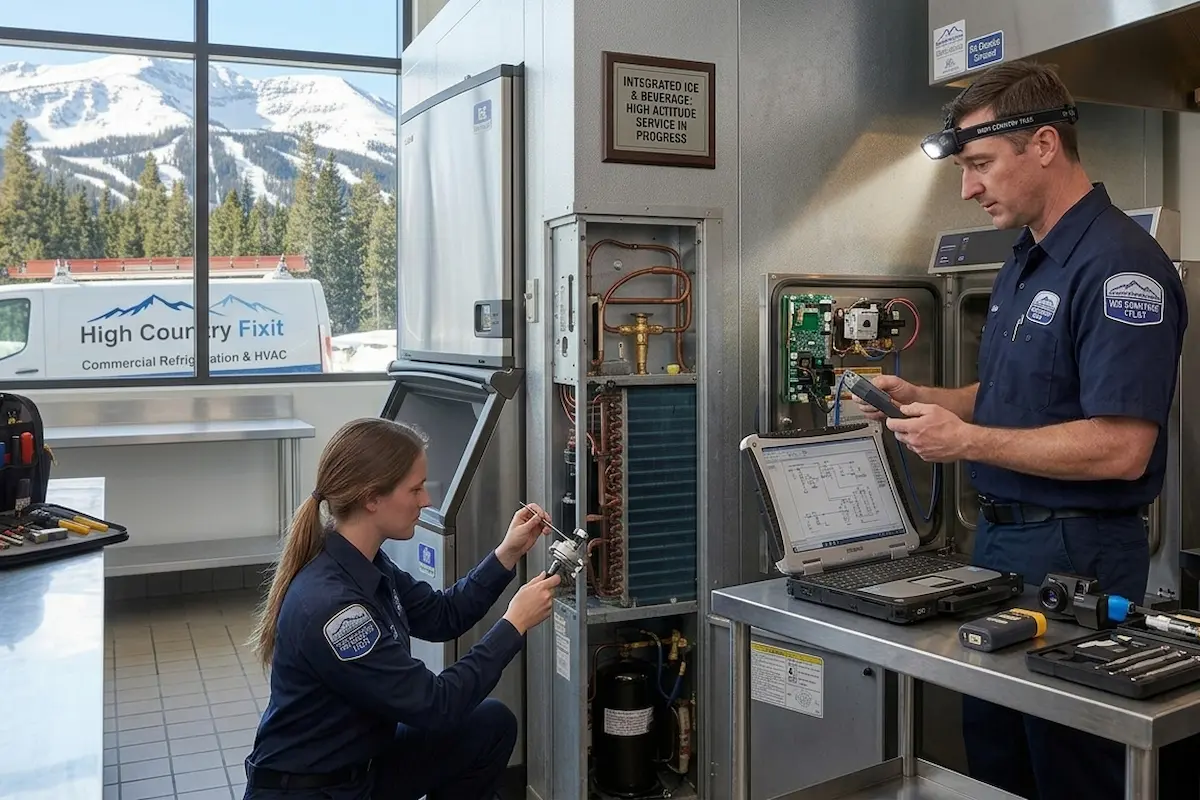
If you think your walk-in is sensitive, wait until you look at your ice maker. Commercial ice machines are notoriously dramatic in high-altitude restaurants. They rely on incredibly precise timing and water temperatures to drop perfect ice cubes into the bin. Because atmospheric pressure is lower, water evaporates rapidly off the freezing plates.
This tricks the machine’s sensors into thinking the ice is ready way too early. The result? You get thin, hollow, or slushy ice cubes that immediately melt in your customers’ drinks. Hard water makes this even worse. Minerals cling to cold evaporator plates much faster at elevation, which clogs up distribution tubes and destroys water pumps in a matter of months.
Steam equipment takes a hit, too. Combi ovens and steamers need their pressure switches recalibrated and cook times extended. If you don’t adjust for the lower boiling point, you risk serving undercooked food.
Kitchen Airflow and HVAC Nightmares
Kitchen exhaust hoods are designed to pull specific air volumes to keep your staff safe from smoke and grease. But standard Cubic Feet per Minute (CFM) calculations don’t work in the mountains. The exhaust fans are moving thinner air, which means they aren’t pulling as much physical mass. To compensate, these hoods have to pull higher volumes of air.
If your make-up air unit isn’t perfectly calibrated to match this, your kitchen develops severe negative air pressure. You’ll literally feel freezing winter air being sucked straight through the dining room doors. Gas fryers and ranges also starve for oxygen up here. Without enough oxygen per combustion cycle, your burners will produce weak, yellow flames.
This covers your expensive cookware in black soot, wastes gas, and spikes the carbon monoxide risk in the kitchen. Even your outdoor heat pumps will struggle to extract warmth from the thin, sub-zero winter air, while boiler flue pipes risk pushing hazardous exhaust gases back indoors due to draft inversions.
The High Country Fix It Solution
You can’t fix altitude-related equipment failures with standard sea-level repair manuals. It requires highly targeted mechanical adjustments by technicians who actually understand mountain thermodynamics. At High Country Fix It, we apply custom engineering tweaks specifically designed for commercial kitchens operating above 8,000 feet in Summit County.
We physically adjust the superheat and subcooling settings on your expansion valves so they meter refrigerant correctly, regardless of the barometric pressure. We also recalibrate fan motor speeds and blade pitches to force more air mass across your coils.
| Equipment Type | The Sea-Level Problem | Our High-Altitude Fix |
| Walk-In Freezers | TXV Pressure Drift | Superheat & Subcooling Retuning |
| Ice Machines | Premature Evaporative Harvest | Pressure Switch Recalibration |
| Exhaust Hoods | Low Air Mass Displacement | Motor RPM & CFM Re-scaling |
| Gas Ranges | Incomplete Fuel Combustion | Gas Orifice Re-sizing & Shutter Tuning |
One of the biggest lifesavers is a strict, bi-monthly maintenance schedule. Up here, even a tiny layer of kitchen grease on a condenser coil will choke a compressor to death. We also install elevation-rated water pressure regulators on incoming supply lines. This simple, cost-effective tweak stabilizes your ice machine’s fill cycles, stops valve chatter, and extends the life of your expensive water filters.
Frequently Asked Questions
Why does my commercial walk-in cooler freeze up at high altitude?
High altitude drops the barometric pressure, which confuses factory expansion valves. They miscalculate the refrigerant flow, causing coil temperatures to plummet below freezing. This turns standard cabinet humidity into thick ice sheets that block airflow.
Do commercial gas fryers and ovens need special adjustments for mountain towns?
Absolutely. Lower oxygen density causes incomplete gas combustion. We have to install smaller gas orifices and adjust the burner air shutters so you get a clean, hot blue flame instead of dangerous carbon monoxide buildup.
How often should mountain restaurants service their commercial HVAC/R systems?
If you are operating above 8,000 feet, you need preventative maintenance at least four times a year. The thin air forces your compressors and fan motors to work about 25 percent harder, which accelerates mechanical wear and tear.
Why is my commercial ice machine producing thin or hollow ice cubes?
Lower boiling points and rapid surface evaporation trick your ice machine into starting its harvest cycle way too early. We fix this by re-tuning the harvest pressure switch and adjusting the water fill timing to match the altitude.