Why Commercial Refrigeration Fails Faster at High Altitude
If you run a kitchen in Summit County, you have probably noticed something the manufacturer never mentioned. Equipment that should last ten years starts giving trouble at six. Compressors run longer than they should. The same walk in cooler that held temperature fine in October struggles by July.
None of that is bad luck, and it usually is not a bad machine either.
Commercial refrigeration at high altitude operates under conditions most equipment was never designed around, and the effects compound quietly over years. Here is what is actually happening inside your equipment above 9,000 feet, and what can be done about it.
What altitude actually does to refrigeration
Every refrigeration system works by moving heat from inside a box to the air outside it. The condenser coil is where that heat gets dumped, and it relies entirely on air passing across it to carry the heat away. Air at 9,000 feet is roughly 30 percent thinner than air at sea level. Your condenser fan still spins at the same speed and still moves the same volume of air, but that air carries far less mass, and mass is what actually absorbs heat.
So the fan looks like it is working. The coil looks clean. And the system is still rejecting significantly less heat than the engineer who designed it assumed it would. Manufacturers know this. Most publish derating charts showing capacity losses of roughly three to four percent for every thousand feet of elevation.
Run that math for Breckenridge at 9,600 feet and you land somewhere near a 30 percent reduction in condenser capacity. The problem is that almost nobody applies those charts when equipment gets specified. A unit sized for a restaurant in Denver gets installed in Frisco, and it spends the rest of its life running behind.
This is why commercial refrigeration repair in mountain towns takes a different approach than it does at lower elevations.
Why compressors work harder up here
When the condenser cannot reject heat efficiently, refrigerant leaves it warmer than it should. That raises condensing temperature, which raises head pressure, which is the pressure the compressor has to push against. Higher head pressure means the compressor draws more current, generates more internal heat, and runs longer to hit the same setpoint. A unit that should cycle for fifteen minutes runs for twenty five instead.
Multiply that across a summer season and the compressor has accumulated years of extra runtime that its bearings, valves, and windings were never rated for. The failure eventually looks sudden. It was not. This is the single biggest reason mountain kitchens replace compressors more often than kitchens on the Front Range. The equipment is not worse. The workload is.
Four problems we see most in mountain kitchens
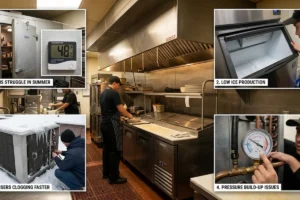
Walk in coolers that hold temperature in winter and lose it in summer. Cold ambient air masks the altitude problem for half the year. Once outdoor temperatures climb, the derated condenser finally runs out of margin and the box drifts warm during the busiest service of the day. Ice machines producing well below their rated output. Ice machines are heat rejection devices with a very tight tolerance for condenser performance.
Thin air plus the low humidity up here changes both the harvest cycle and the production rate, and a machine rated at 500 pounds may realistically deliver far less. Systems that will not build head pressure on cold nights. This is the opposite failure and it catches people off guard. When it drops to five degrees outside, an air cooled condenser can reject too much heat, pressure falls, and the expansion valve stops feeding the evaporator properly.
The box warms up on the coldest night of the year. Condensers clogged faster than anyone expects. Summer brings dust and cottonwood. Winter brings snow drift and ice buildup. A coil that is already working at reduced capacity has no room to absorb a restriction on top of that. Those published capacity figures come from AHRI test conditions at sea level, which is why the number on the spec sheet and the number in your bin rarely match up here.
What this looks like in a real kitchen
This section should describe one actual service call. What the symptom was, what the customer had already tried, what the real cause turned out to be, and what fixed it. Business name can stay out of it if preferred. Something like “a restaurant in Frisco called us three times in one season for the same walk in cooler” works fine and keeps it honest.
This is the most valuable section on the page. Search engines and customers both weight real experience above general advice, and it is the part no competitor can copy.
What breaks first, and the warning signs
Compressors get the blame, but they are usually the last thing to go rather than the first. The failures ahead of them are quieter and much cheaper to catch. Condenser fan motors go early because they run more hours. Contactors pit and weld from repeated long cycles. Expansion valves lose calibration when they spend years operating outside their intended pressure range.
Watch for run times getting longer without the load changing, a compressor that feels hotter than usual to the hand, ice forming where it did not form last year, and temperature that recovers slowly after the door has been open during a rush. Any one of those on its own might mean nothing. Two together on the same unit usually means something is drifting, and drift is far cheaper to fix than failure.
Equipment across Breckenridge, Frisco, and Dillon shows these same patterns every season, which is why catching drift early matters more up here than it does at lower elevations.
How we adjust service for high country equipment
The gauge readings a technician learns at sea level do not translate directly up here, and this is where a lot of otherwise good service goes wrong. Head pressure that would signal a serious problem in Denver can be normal in Breckenridge. A technician who reacts to that number by removing refrigerant leaves the system undercharged, and the customer ends up worse off than before the call.
Our approach is to size and evaluate against actual elevation rather than nameplate ratings. That means checking superheat and subcooling against altitude adjusted targets, verifying that condensers have adequate capacity for the site instead of assuming factory specs apply, and installing head pressure controls where winter operation demands them.
For equipment that is already undersized for its elevation, the fix is often not replacement. Improving airflow across the condenser, adding a fan cycling control, or correcting installation clearances can recover a meaningful share of the lost capacity.
When to call a technician
Call before the failure, not during service. The economics up here are straightforward. A condenser cleaning and a proper pressure check cost a fraction of a compressor replacement, and almost nothing compared to a walk in full of spoiled product on a Saturday in ski season. Twice a year is the right rhythm for most mountain kitchens. Once heading into summer when the heat load peaks, and once before winter when low ambient problems start.
If your equipment is already showing any of the warning signs above, get it looked at now rather than after the next rush. High Country Fix It services commercial refrigeration and restaurant equipment across Breckenridge, Keystone, Copper, Dillon, Silverthorne, Frisco, Vail, and Eagle. Our technicians are EPA 608 certified and work at these elevations every day.
Frequently asked questions
Does high altitude really affect commercial refrigeration that much?
Yes. Most manufacturers publish capacity losses of roughly three to four percent per thousand feet of elevation. At Summit County elevations that adds up to a meaningful reduction in what your condenser can actually do.
My equipment worked fine for years. Why is it struggling now?
Altitude does not cause sudden failure. It shortens the margin your system has, so components wear faster and problems that would have stayed hidden at sea level eventually surface here.
Can I just buy a bigger unit to solve this?
Sometimes, but oversizing brings its own problems including short cycling and poor humidity control. Correct sizing for your actual elevation matters more than simply going larger.
Why does my walk in cooler struggle in summer but not winter?
Cold outside air compensates for the thin air and hides the problem. Once ambient temperatures climb, the reduced condenser capacity runs out of margin and the box drifts warm.
How often should mountain kitchen equipment be serviced?
Twice a year for most operations. Once before summer when heat load peaks, and once before winter when low ambient problems begin.
Will any HVAC technician understand altitude adjustments?
Not always. Gauge readings that signal trouble at sea level can be normal at 9,000 feet. A technician who reacts to those numbers without adjusting for elevation can leave a system undercharged.